“What does SPY cost me per $10,000, against the other S&P 500 funds?”
US ETFs · European UCITS ETFs by ISIN or ticker
ETF Analysis
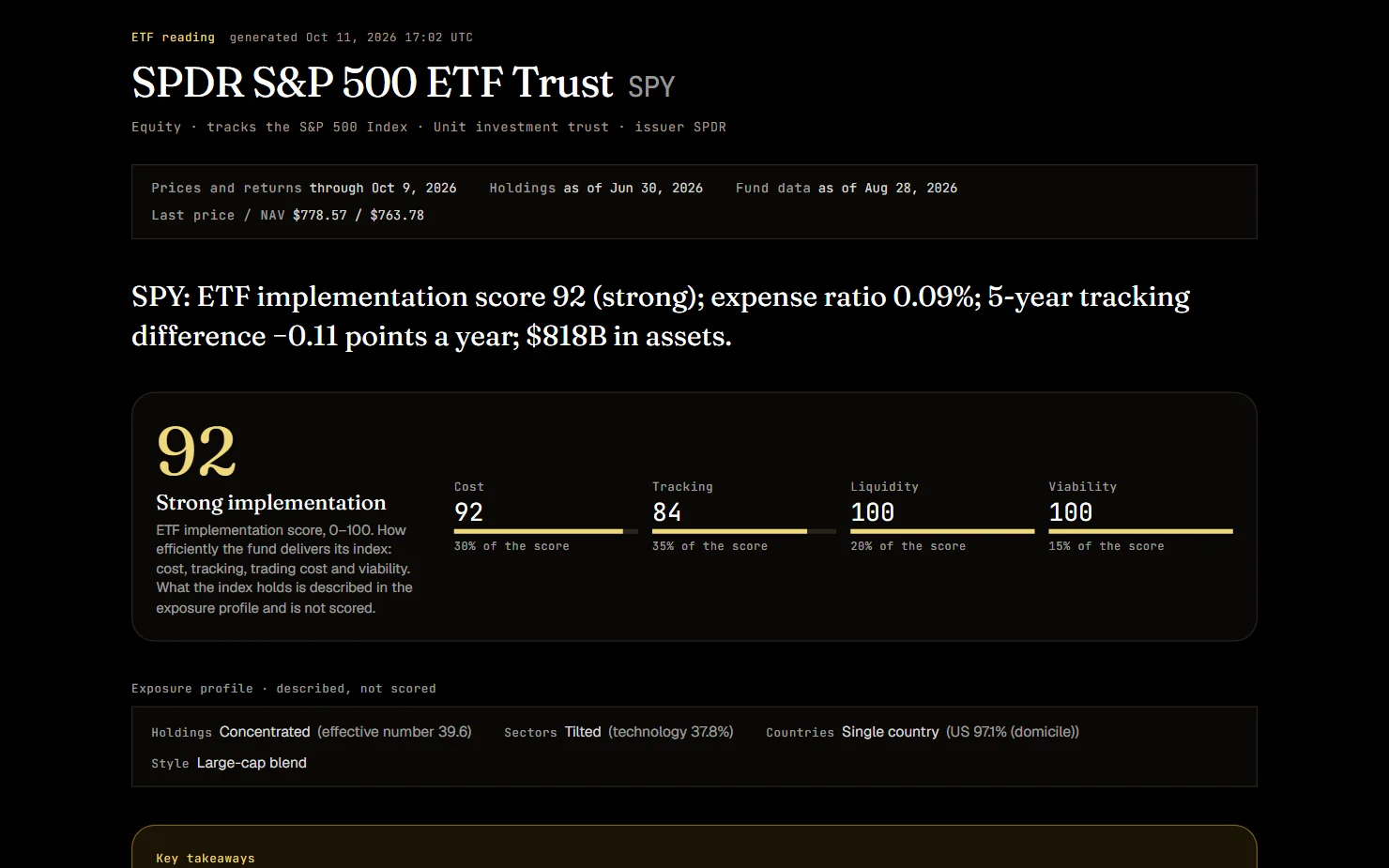
What is inside this fund, what does it cost, and does it track its index? For your first ETF, or for when two funds look the same and you cannot tell why one costs more.
Research report for informational purposes only — not investment advice.
What you ask it
“How well does VUAA track its index?”
“What is the overlap between QQQ and SCHG?”
What you will see
- Key takeaways, then an overview: the index rules and the legal structure.
- Cost per $10,000, next to funds on the same index.
- Tracking difference and tracking error, per period.
- Liquidity: bid–ask spread, size, age.
- Holdings: the effective number of names, and the clusters.
- Sectors and countries, from the fund’s own SEC filing.
- Performance against the index and the S&P 500; risk: volatility, beta, maximum drawdown, worst year.
- Overlap with related funds, and the fundamentals of the 25 largest holdings.
- Score commentary.
How the score is built
An implementation score from 0 to 100 — strong, solid, mixed, weak or poor — from four dimensions: cost, tracking, liquidity, viability. What the fund holds is described, not scored: exposure is a choice you make, not a quality of the fund. A European UCITS ETF is recognised by ISIN or ticker and mapped to the US fund on the same index.
Where the data come from
- The fund’s own SEC filings (N-PORT, the prospectus)
- Index data
- Licensed market data for prices, spreads and size
Every figure in the report carries its source and date.
What it will not do
- It does not tell you to buy or sell.
- It does not set a price target.
- It does not score what the fund holds: a sector or a country is described, and the choice is left to you.
When it fails, you are not charged
If the fund has no holdings filing to read, the report stops and the credits come back automatically.
Which plans, and what it costs
Ask
5 credits
Starter
5 credits
Professional
3 credits
Elite
2 credits
Or once, without a subscription: $12. The report stays open for 7 days.
Read the report properly
The guide says what this report measures, how to read its sections in order, and what it does not tell you.
Reports, summaries and chat answers are generated by AI from public and licensed market data; they may contain errors and are research and education, not investment advice.